In ALEXX SkyRider™, survival is not only about avoiding enemies.
Sometimes the most important decisions come from objects that appear useful, dangerous or uncertain.
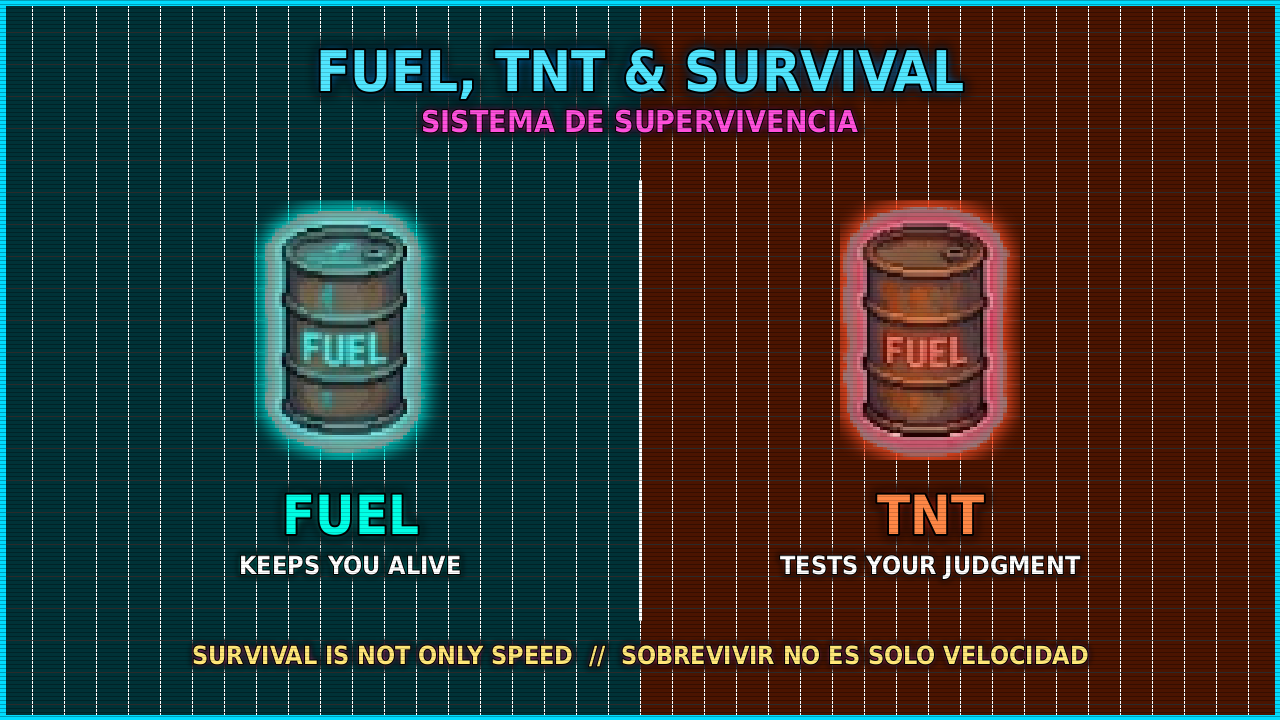
Fuel and TNT are a good example.
One keeps the ship alive.
The other can end a life instantly.
But the real challenge is not simply knowing which one is good and which one is bad.
The challenge is deciding:
Is it worth changing my route for what I see ahead?
That decision can become just as important as firing at an enemy.
FUEL CREATES PRESSURE
Fuel is necessary because the ship continuously consumes it.
That means Fuel is never just decoration.
When it appears, the player immediately has something else to think about.
Do I need it now?
Can I reach it safely?
What will happen to my position if I move toward it?
Will chasing it leave me trapped a second later?
The instinct to collect Fuel can be strong, especially when the gauge begins to drop.
But survival depends on more than grabbing everything that appears.
Sometimes the safest decision is to take the Fuel.
Sometimes the safest decision is to let it go.
That is where strategy begins.
NOT EVERY REWARD IS WORTH THE ROUTE
A useful object can still lead you into danger.
Fuel may appear in a position that requires the ship to cross the screen.
It may be surrounded by enemies or obstacles.
It may force you toward one side when the next opening is developing somewhere else.
The Fuel itself is not the problem.
The route toward it can be.
That is why I think of Fuel as a test of judgment.
The player is constantly balancing two needs:
restore energy
and
protect the ship.
If reaching Fuel creates more danger than the reward can solve, the decision may not be worth it.
SLOWING DOWN CAN CREATE A BETTER APPROACH
Speed changes the way Fuel decisions feel.
At high speed, an opportunity appears and disappears quickly.
The player has less time to evaluate the surrounding route.
At a slower pace, it becomes easier to see whether a Fuel pickup is really reachable without losing control.
That does not mean you always need to slow down.
It means braking can give you options.
A controlled approach can be better than an emergency turn at the last second.
You can position the ship earlier.
You can read what is around the Fuel.
You can decide whether the path remains open.
Fuel rewards players who think beyond the object itself.
TNT CHANGES CERTAINTY INTO DOUBT
TNT creates a different kind of pressure.
Not every barrel is safe.
Some reveal themselves as TNT as the player approaches.
That changes the decision immediately.
A path that looked useful can become dangerous.
A movement that seemed correct may need to be abandoned.
The player has to react, but also remain calm enough to find another route.
Touching TNT causes an explosion and costs a life.
So the important skill is not only recognizing TNT.
It is keeping enough control to change your decision when new information appears.
LEAVE YOURSELF AN EXIT
One of the worst situations is committing so heavily to one object or one side of the screen that there is nowhere left to move.
Fuel and TNT both teach the same larger lesson:
always protect an escape route.
When moving toward Fuel, ask what space will remain if something changes.
When approaching a barrel, be ready for the possibility that it may not be safe.
When the screen becomes crowded, avoid placing the ship where only one movement is possible.
You do not need to know everything in advance.
You need enough space to react when the route gives you new information.
GREED CAN BE EXPENSIVE
Arcade games often encourage collecting.
Something appears, and the natural instinct is to grab it.
ALEXX SkyRider™ sometimes asks the opposite question:
Can you leave something behind?
That can be surprisingly difficult.
A Fuel pickup may be close enough to tempt you.
You may think you can reach it before the route closes.
You may take one more risk because the reward looks important.
And sometimes it works.
Other times, that decision costs more than the Fuel was worth.
Learning when not to collect something is part of becoming a better pilot.
TNT REWARDS EARLY RECOGNITION
When TNT reveals itself, the safest reaction usually begins with what happened before the reveal.
Were you already moving too fast?
Were you trapped against the edge?
Did you have another route available?
Were you watching only the object, or were you still reading the rest of the screen?
The earlier the player reads the whole situation, the easier it becomes to respond.
That is why TNT is not only a hazard.
It is a test of route awareness.
THE DECISION IS BIGGER THAN THE OBJECT
Fuel and TNT may look like separate mechanics, but both influence the same skill:
judgment under pressure.
Fuel asks whether a reward is worth the risk.
TNT asks whether you can change your plan when something becomes dangerous.
Both depend on:
- speed control;
- positioning;
- route reading;
- patience;
- keeping an escape path.
That makes them more than pickups or hazards.
They become part of the way the player learns to think.
SURVIVAL IS NOT ALWAYS AGGRESSIVE
A good run does not require forcing every opportunity.
Sometimes survival comes from restraint.
Letting Fuel go.
Braking before a crowded section.
Changing direction early.
Refusing to commit to a dangerous path.
Avoiding a barrel when there is not enough room to react safely.
Those decisions may look less dramatic than shooting an enemy, but they can keep a run alive.
FUEL REWARDS CONTROL. TNT TESTS JUDGMENT.
That is the relationship I see between these two elements.
Fuel creates temptation because the ship needs it.
TNT creates uncertainty because what looks harmless can become dangerous.
Together, they force the player to think beyond simple movement.
The question is not only:
Can I reach it?
The better question is:
Can I reach it and still stay in control afterward?
That difference matters.
Because in ALEXX SkyRider™, survival is often decided before the collision happens.
It is decided in the moment when the pilot chooses the route.