Face 1 - Day is the beginning of the Main Arcade journey.
It is also where one of the most important habits in ALEXX SkyRider™ starts to develop:
read the route before you commit to it.
At first, it is easy to focus only on what is directly in front of the ship.
An enemy appears, so you react.
Fuel appears, so you move toward it.
An opening appears, so you enter it.
But the longer you play, the more you realize that surviving is not only about responding to what is happening now.
It is about recognizing what the route is becoming.
That difference matters.
A safe position can become dangerous a moment later.
A tempting pickup can pull you into the wrong side of the screen.
A quick movement can leave you with no escape when the next obstacle arrives.
Face 1 is where the player begins learning to see those situations before they become traps.
DO NOT WAIT UNTIL THE ROUTE IS CLOSED
One of the easiest mistakes to make is staying in a position too long.
A section may look open.
You may feel comfortable in the center.
You may think there is still plenty of room.
Then enemies, obstacles or the shape of the route begin to reduce your options.
By the time the danger becomes obvious, moving out can be much harder.
That is why early movement is so important.
The goal is not to escape once the trap is complete.
The goal is to recognize that the trap is forming.
If the space ahead is getting tighter, begin positioning the ship before the situation becomes urgent.
A small adjustment made early is usually easier than a desperate correction made late.
READ THE LOWER PART OF THE SCREEN
Because ALEXX SkyRider™ uses downward vertical action, the lower part of the screen deserves constant attention.
That is where the next decisions are arriving.
Do not look only at the ship.
Do not look only at the enemy you are firing at.
Your eyes need to move between the immediate danger and the route that is developing below.
The more you do that, the earlier you begin to recognize:
- openings;
- crowded areas;
- possible escape routes;
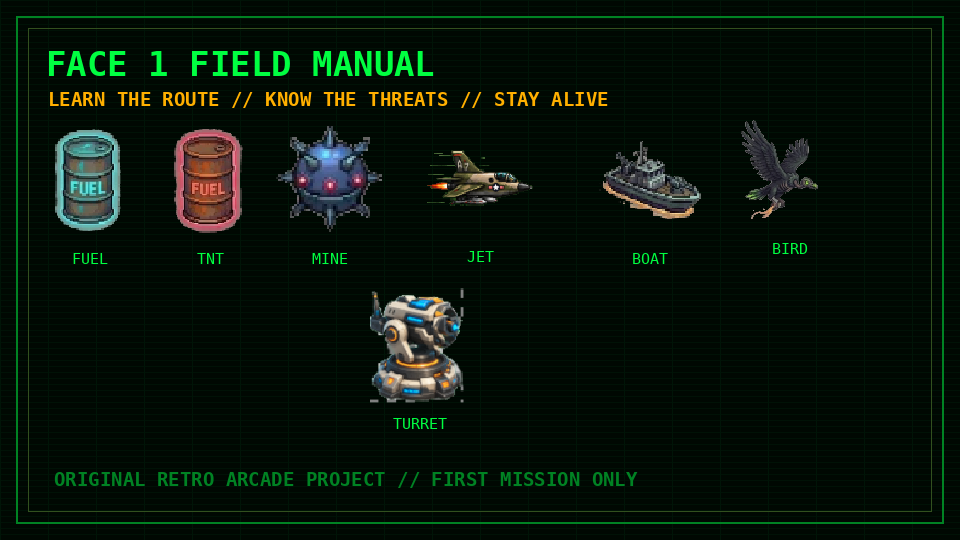
- Fuel opportunities;
- barrels that may require caution;
- positions that may become difficult to leave.
This habit becomes more important as the route becomes harder.
Face 1 is a good place to begin developing it.
POSITION BEFORE YOU NEED THE POSITION
Good positioning often happens before the danger appears.
If you wait until an obstacle is directly in front of you, your choices are already limited.
If you begin moving earlier, you can approach the same section with more control.
Think of the ship's position as preparation.
You are not only avoiding what is on the screen now.
You are trying to place the ship where the next decision will be easier.
Sometimes that means staying near the center.
Sometimes it means moving toward one side.
Sometimes it means refusing to chase an object because the better position is somewhere else.
The correct position changes with the route.
The important part is thinking about it before the screen forces the decision.
SPEED CAN TURN A SIMPLE SECTION INTO A HARD ONE
A route that feels manageable at one speed can become much more difficult when entered too fast.
Higher speed reduces the time available to:
- identify threats;
- choose an opening;
- reach Fuel safely;
- avoid TNT;
- correct poor positioning.
That does not mean the player should always move slowly.
It means speed should match how well you are reading the route.
If you are uncertain about what is coming, slowing down can give you time to understand the section.
If the route is clear and you have space, accelerating may be perfectly reasonable.
The important thing is not allowing speed to make the decision for you.
You control the speed. The speed should not control the run.
DO NOT CHASE EVERYTHING
Face 1 also begins teaching another useful arcade habit:
not every object deserves your attention.
Fuel is important.
Enemies matter.
Openings matter.
But trying to respond to everything at once can pull the ship out of position.
A Fuel pickup may be useful, but not if reaching it removes your escape route.
An enemy may be directly in front of you, but avoiding another threat may be more important than destroying it immediately.
A clear path may be more valuable than one extra action.
This is one of the moments where ALEXX SkyRider™ becomes less about reacting automatically and more about choosing priorities.
KEEP AN ESCAPE ROUTE
Before entering a tight area, ask yourself one simple question:
If something changes, where can I go?
That question can prevent many unnecessary collisions.
If the answer is “nowhere,” the position is probably too risky.
Leaving an escape route does not mean staying far away from everything.
It means avoiding situations where only one movement remains possible.
The more options you preserve, the easier it becomes to respond when the screen changes.
That is especially important when enemies, obstacles, Fuel and TNT begin competing for your attention at the same time.
LEARN FROM THE COLLISION
A collision is frustrating, but it can also show you where your reading failed.
After a crash, it helps to ask:
Did I enter too fast?
Was I looking only at one enemy?
Did I chase Fuel into a bad position?
Did I wait too long before moving?
Did I leave myself without an exit?
Was the mistake in the final second, or did it actually begin several seconds earlier?
That last question is important.
Many crashes feel sudden, but the decision that caused them may have happened before the impact.
Recognizing that is part of learning the route.
MEMORY HELPS, BUT CONTROL MATTERS MORE
Repeated runs naturally build memory.
You begin to recognize sections.
You remember where pressure increased.
You notice where you had trouble before.
That knowledge is useful.
But memorizing a route is not the same as controlling the ship.
The player still needs to react to what is happening on the screen.
Speed still changes timing.
Position still matters.
A mistake can still force a different recovery.
The best use of memory is not to play mechanically.
It is to give yourself more time to make better decisions.
FACE 1 IS WHERE THE HABIT BEGINS
Face 1 is the beginning, but the habits learned there continue through the entire arcade journey.
Read before accelerating.
Move before the screen forces you to move.
Protect your escape route.
Do not chase every object.
Use braking when you need more information.
Treat collisions as lessons.
Those ideas become more important as the journey continues through Night, Cemetery, Snow and Canyon.
The environments change.
The pressure changes.
But the basic skill remains the same:
understand the route before the route takes away your options.
READ FIRST. MOVE SECOND.
The best way to approach Face 1 is not to think only about surviving the next second.
Think about preparing for the next few seconds.
Watch what is entering the screen.
Control your speed.
Choose your position.
Leave yourself space.
And make the decision before the route becomes a trap.
That is one of the first lessons ALEXX SkyRider™ teaches.
Read first. Move second. Survive longer.