ALEXX SkyRider™
DEVELOPMENT & PILOT JOURNAL
CRT MEMORY ONLINE · AUDIO SYSTEM ARMED
PLAYABLE DEMOS AVAILABLE

WHY TIME ATTACK BECAME THE TRAINING GROUND

Time Attack began as a different way to play ALEXX SkyRider™, but over time it became something more important:

a place to learn the ship.

The clock creates pressure, but speed alone is not the real lesson.

Time Attack became useful because it forces the player to understand how movement, braking, route reading and reaction time work together.

In Main Arcade, all of those skills are already being tested while the journey continues through different Faces.

Time Attack gives those same skills a more focused purpose.

It is where you can learn how the ship feels before the route becomes less forgiving.
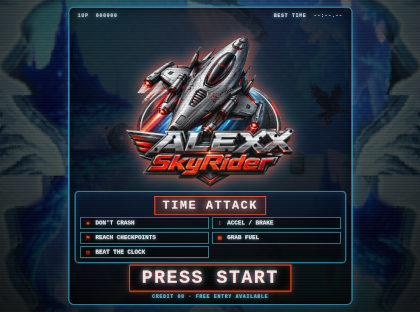
ALEXX SkyRider Time Attack artwork with PRESS START screen and challenge objectives.
Time Attack project artwork with its PRESS START screen and challenge objectives.

SPEED IS NOT JUST ABOUT GOING FASTER

One of the most important ideas behind Time Attack is learning the ship at three different speeds.

Each speed changes the experience.

At a slower pace, the player has more time to observe the route and make corrections.

At a faster pace, information arrives sooner and mistakes become harder to recover from.

The route may be familiar, but the amount of time available to understand it changes.

That is why I do not see the three speeds as simple difficulty levels.

They are three different ways of reading the same kind of challenge.

The faster the ship moves, the more precise the player's decisions need to become.

BRAKING BECAME A SKILL

In many arcade games, pressing forward feels natural.

Going faster can feel like progress.

Time Attack taught me that in ALEXX SkyRider™, braking can be just as important as accelerating.

There are moments when the best decision is not to push harder.

It is to create more time.

Braking can give you a moment to understand what is entering the route.

It can help you position the ship before a difficult section.

It can prevent a fast run from becoming an uncontrolled run.

That makes braking part of the strategy rather than a sign that the player is losing momentum.

The fastest run is not necessarily the one where the ship stays at maximum speed every second.

A better run can come from knowing exactly when speed helps and when it begins to work against you.

THE CLOCK MAKES MISTAKES FEEL DIFFERENT

Time Attack adds one element that changes the pressure immediately:

the clock keeps moving.

A collision does not simply interrupt the action.

It costs rhythm.

It costs time.

After a crash, the player has to recover and continue.

That makes each mistake feel connected to the final result.

A small error early in the run can remain important several sections later.

This changes the way the player thinks about risk.

Is it worth forcing a narrow opening to save a little time?

Is accelerating now really faster if it increases the chance of crashing?

Would slowing down for a moment create a cleaner run overall?

Time Attack turns those questions into part of the gameplay.

A CLEAN RUN CAN BE FASTER THAN AN AGGRESSIVE RUN

At first, it is easy to think that Time Attack is about one thing:

go as fast as possible.

But that approach can quickly create problems.

If you enter every section at maximum speed, you reduce your reaction time.

If you constantly make last-second corrections, you increase the chance of losing control.

And if those mistakes lead to collisions, the time you thought you were saving disappears.

That is where another lesson appears:

control can create speed.

A clean route with fewer mistakes can be more effective than a reckless route that looks faster moment by moment.

The player starts looking beyond immediate speed and thinking about the entire run.

That is a different kind of arcade pressure.

LEARNING WHEN TO COMMIT

Every route creates decisions.

Sometimes there is an opening that looks safe.

Sometimes Fuel appears in a position that requires a change of direction.

Sometimes a section becomes crowded and the player has to decide quickly where the safest space will be.

Time Attack makes those decisions more intense because hesitation also costs time.

But rushing can cost even more.

The player has to learn when to commit to a direction and when to wait another moment.

That skill is difficult to describe with a single control instruction.

You learn it through repeated runs.

You begin to recognize situations sooner.

You make decisions earlier.

And eventually, sections that once required a last-second reaction begin to feel more predictable.

THREE SPEEDS, THREE DIFFERENT LESSONS

The three-speed structure became useful because each level of speed exposes something different.

At a more manageable speed, the player can concentrate on:

  • understanding the route;
  • positioning the ship;
  • recognizing threats;
  • learning where braking helps.

At higher speeds, those same skills are tested under greater pressure.

There is less time to think.

The player begins depending more on anticipation and recognition.

What was once a conscious decision can gradually become instinct.

That progression is important.

The goal is not simply to prove that you can survive at the fastest speed.

The goal is to understand why you are still in control when everything starts moving faster.

TRAINING FOR MAIN ARCADE

This is where Time Attack connects directly with Main Arcade.

Main Arcade is the larger journey.

It combines the five Faces, changing environments, enemies, obstacles, Fuel, TNT and survival.

Time Attack does not replace that experience.

It prepares you for it.

The skills developed while training carry into Main Arcade:

reading the lower part of the screen;

recognizing when a route is closing;

using braking intentionally;

choosing when to accelerate;

recovering from mistakes;

and keeping the ship under control when pressure increases.

That is why I eventually began to see Time Attack as a training ground rather than simply another mode.

THE NIGHT FACE DEMO

A playable Time Attack demo is currently available from the official site.

It uses a section of the Night Face with two bridges and infinite lives.

That makes it a useful place to experience the basic Time Attack philosophy without the pressure of a limited-life system.

The player can concentrate on movement, braking, speed and route reading.

That is exactly what the mode is meant to teach.

The demo does not need to explain the lesson with a long tutorial.

The route itself does the teaching.

IMPROVEMENT BECOMES VISIBLE

One of the things I enjoy about Time Attack is that improvement becomes easy to notice.

A section that once forced you to brake heavily may eventually become comfortable.

A route that seemed chaotic begins to show patterns.

You start making fewer emergency movements.

You stop reacting to every object separately and begin reading the section as a whole.

And eventually the clock reflects that improvement.

That is why personal progress matters more to me here than simply chasing a number.

A better time is interesting because it represents something underneath it:

better control.

WHY TIME ATTACK STAYED

Time Attack could have remained a simple alternate mode built around a clock.

Instead, it found a more useful role inside ALEXX SkyRider™.

It became the place where speed can be studied.

Where braking can be practiced.

Where routes can be learned.

Where mistakes can be understood.

And where the player can develop the control needed for the larger arcade journey.

The clock is still important.

The challenge is still to improve your run.

But the deeper purpose became clear:

Time Attack is where you learn to fly faster without losing control.

That is why it became the training ground.

BACK TO GAMEPLAY ANALYSIS
PREVIOUS ARTICLEWHY DOWNWARD VERTICAL ACTION CHANGES THE WAY YOU READ THE ROUTENEXT ARTICLEFUEL vs TNT: SURVIVAL IS A DECISION

POR QUÉ TIME ATTACK SE CONVIRTIÓ EN EL CAMPO DE ENTRENAMIENTO

Time Attack comenzó como una forma diferente de jugar ALEXX SkyRider™, pero con el tiempo se convirtió en algo más importante:

un lugar para aprender a dominar la nave.

El reloj genera presión, pero la velocidad por sí sola no es la verdadera lección.

Time Attack se volvió útil porque obliga al jugador a comprender cómo se relacionan el movimiento, el frenado, la lectura de ruta y el tiempo de reacción.

En Arcade Principal, todas esas habilidades ya están siendo puestas a prueba mientras el recorrido continúa por diferentes Faces.

Time Attack les da un propósito más concentrado.

Es el lugar donde puedes aprender cómo responde la nave antes de que la ruta sea menos tolerante con los errores.

Arte de ALEXX SkyRider Time Attack con pantalla PRESS START y objetivos del desafío.
Arte del proyecto de Time Attack con su pantalla PRESS START y objetivos del desafío.

LA VELOCIDAD NO CONSISTE SOLAMENTE EN IR MÁS RÁPIDO

Una de las ideas más importantes de Time Attack es aprender a manejar la nave en tres velocidades diferentes.

Cada velocidad cambia la experiencia.

A un ritmo más lento, el jugador tiene más tiempo para observar la ruta y realizar correcciones.

A mayor velocidad, la información llega antes y los errores son más difíciles de corregir.

La ruta puede resultar familiar, pero cambia el tiempo disponible para comprenderla.

Por eso no considero las tres velocidades simplemente como niveles de dificultad.

Son tres maneras diferentes de leer un mismo tipo de desafío.

Mientras más rápido se mueve la nave, más precisas deben ser las decisiones del jugador.

FRENAR SE CONVIRTIÓ EN UNA HABILIDAD

En muchos juegos arcade, avanzar constantemente se siente natural.

Ir más rápido puede sentirse como progreso.

Time Attack me enseñó que en ALEXX SkyRider™, frenar puede ser tan importante como acelerar.

Hay momentos en los que la mejor decisión no es presionar más.

Es crear más tiempo.

Frenar puede darte un momento para comprender lo que está entrando en la ruta.

Puede ayudarte a colocar la nave antes de una sección complicada.

Puede evitar que una partida rápida se convierta en una partida sin control.

Eso hace que el frenado forme parte de la estrategia y no sea una señal de que el jugador está perdiendo ritmo.

La partida más rápida no necesariamente es aquella donde la nave permanece a máxima velocidad cada segundo.

Una mejor partida puede surgir de saber exactamente cuándo la velocidad ayuda y cuándo comienza a trabajar en tu contra.

EL RELOJ HACE QUE LOS ERRORES SE SIENTAN DIFERENTES

Time Attack agrega un elemento que cambia inmediatamente la presión:

el reloj continúa avanzando.

Un choque no solamente interrumpe la acción.

Cuesta ritmo.

Cuesta tiempo.

Después de una colisión, el jugador tiene que recuperarse y continuar.

Eso hace que cada error se mantenga conectado con el resultado final.

Un pequeño fallo al principio de la partida puede seguir siendo importante varias secciones después.

Esto cambia la manera de pensar el riesgo.

¿Vale la pena forzar una abertura estrecha para ahorrar un poco de tiempo?

¿Acelerar ahora realmente será más rápido si aumenta la posibilidad de chocar?

¿Disminuir un momento puede producir una partida más limpia en general?

Time Attack convierte esas preguntas en parte de la jugabilidad.

UNA PARTIDA LIMPIA PUEDE SER MÁS RÁPIDA QUE UNA PARTIDA AGRESIVA

Al principio es fácil pensar que Time Attack trata de una sola cosa:

avanzar tan rápido como sea posible.

Pero esa estrategia puede generar problemas rápidamente.

Si entras a cada sección a máxima velocidad, reduces tu tiempo de reacción.

Si constantemente haces correcciones en el último segundo, aumenta la posibilidad de perder el control.

Y si esos errores terminan en choques, el tiempo que creías estar ahorrando desaparece.

Ahí aparece otra lección:

el control también puede producir velocidad.

Una ruta limpia con menos errores puede ser más efectiva que una ruta agresiva que parece más rápida segundo a segundo.

El jugador deja de pensar únicamente en la velocidad inmediata y comienza a considerar la partida completa.

Esa es otra forma de presión arcade.

APRENDER CUÁNDO COMPROMETERSE CON UNA DECISIÓN

Cada ruta genera decisiones.

A veces aparece una abertura que parece segura.

A veces Fuel aparece en una posición que exige cambiar de dirección.

A veces una sección se satura y el jugador tiene que decidir rápidamente dónde estará el espacio más seguro.

Time Attack hace esas decisiones más intensas porque dudar también cuesta tiempo.

Pero precipitarse puede costar todavía más.

El jugador necesita aprender cuándo comprometerse con una dirección y cuándo esperar un momento adicional.

Esa habilidad es difícil de explicar con una sola instrucción de control.

Se aprende mediante partidas repetidas.

Comienzas a reconocer situaciones con mayor anticipación.

Tomas decisiones antes.

Y eventualmente, secciones que antes exigían una reacción de último segundo comienzan a sentirse más predecibles.

TRES VELOCIDADES, TRES LECCIONES DIFERENTES

La estructura de tres velocidades se volvió útil porque cada nivel expone algo diferente.

A una velocidad más manejable, el jugador puede concentrarse en:

  • comprender la ruta;
  • posicionar la nave;
  • reconocer amenazas;
  • aprender dónde ayuda el frenado.

A velocidades mayores, esas mismas habilidades se ponen a prueba bajo más presión.

Hay menos tiempo para pensar.

El jugador comienza a depender más de la anticipación y el reconocimiento.

Lo que antes era una decisión consciente poco a poco puede convertirse en instinto.

Esa progresión es importante.

El objetivo no consiste solamente en demostrar que puedes sobrevivir a la máxima velocidad.

El objetivo es comprender por qué sigues teniendo el control cuando todo comienza a moverse más rápido.

ENTRENAMIENTO PARA ARCADE PRINCIPAL

Aquí es donde Time Attack se conecta directamente con Arcade Principal.

Arcade Principal es el recorrido mayor.

Combina las cinco Faces, ambientes cambiantes, enemigos, obstáculos, Fuel, TNT y supervivencia.

Time Attack no sustituye esa experiencia.

Te prepara para ella.

Las habilidades desarrolladas durante el entrenamiento se trasladan a Arcade Principal:

leer la parte inferior de la pantalla;

reconocer cuándo una ruta comienza a cerrarse;

utilizar el frenado de forma intencional;

elegir cuándo acelerar;

recuperarse después de los errores;

y mantener el control de la nave cuando aumenta la presión.

Por eso terminé viendo Time Attack como un campo de entrenamiento y no simplemente como otro modo.

EL DEMO DE FACE NOCHE

Actualmente hay un demo jugable de Time Attack disponible desde el sitio oficial.

Utiliza una sección de la Face Noche con dos puentes y vidas infinitas.

Eso lo convierte en un buen lugar para experimentar la filosofía básica de Time Attack sin la presión de un sistema de vidas limitadas.

El jugador puede concentrarse en movimiento, frenado, velocidad y lectura de ruta.

Eso es exactamente lo que este modo busca enseñar.

El demo no necesita explicar la lección mediante un tutorial largo.

La propia ruta se encarga de enseñarla.

LA MEJORA SE VUELVE VISIBLE

Una de las cosas que disfruto de Time Attack es que la mejora comienza a notarse con facilidad.

Una sección que antes te obligaba a frenar demasiado puede terminar sintiéndose cómoda.

Una ruta que parecía caótica comienza a mostrar patrones.

Empiezas a realizar menos movimientos de emergencia.

Dejas de reaccionar a cada objeto por separado y comienzas a leer la sección completa.

Y eventualmente el reloj refleja esa mejora.

Por eso el progreso personal me interesa más aquí que simplemente perseguir un número.

Un mejor tiempo resulta interesante porque representa algo que existe debajo de esa cifra:

mejor control.

POR QUÉ TIME ATTACK PERMANECIÓ

Time Attack pudo quedarse como un simple modo alternativo construido alrededor de un reloj.

En cambio, encontró una función más útil dentro de ALEXX SkyRider™.

Se convirtió en el lugar donde se puede estudiar la velocidad.

Donde se puede practicar el frenado.

Donde se pueden aprender las rutas.

Donde se pueden comprender los errores.

Y donde el jugador puede desarrollar el control necesario para el recorrido arcade más grande.

El reloj sigue siendo importante.

El desafío continúa siendo mejorar tu partida.

Pero el propósito más profundo terminó quedando claro:

Time Attack es donde aprendes a volar más rápido sin perder el control.

Por eso se convirtió en el campo de entrenamiento.

REGRESAR A GAMEPLAY ANALYSIS
ARTÍCULO ANTERIORPOR QUÉ LA ACCIÓN VERTICAL DE BAJADA CAMBIA LA FORMA DE LEER LA RUTASIGUIENTE ARTÍCULOFUEL vs TNT: SOBREVIVIR ES TOMAR DECISIONES