
Long before ALEXX SkyRider™ had five Faces, Time Attack, its own enemies or its downward vertical action, there was something much simpler behind the idea: a memory.
As a child, I played the flight and arcade challenges of the 1980s. What stayed with me after all those years was not only a particular screen or a specific enemy. It was the feeling.
The pressure of trying to stay alive. Learning a route little by little. Reacting a fraction of a second faster than the previous attempt. Crashing, starting again and realizing that the next run could be better because you already knew something you did not know before.
That old-school tension stayed in my memory.
Years later, that feeling became the starting point for ALEXX SkyRider™.
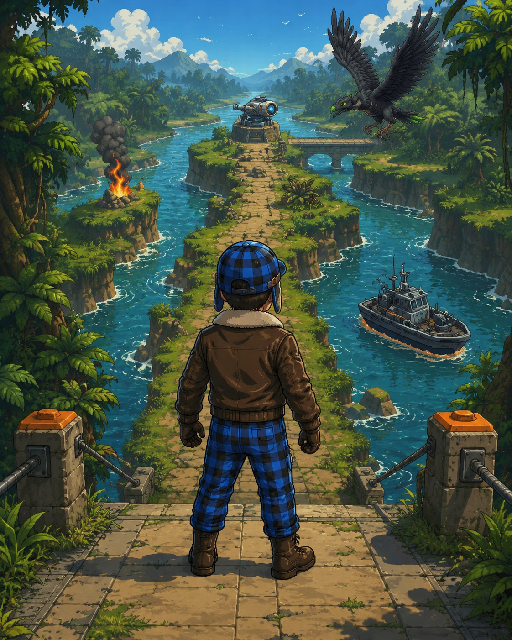
THE MEMORY WAS THE INSPIRATION - NOT THE BLUEPRINT
From the beginning, the goal was never to remake an old game.
ALEXX SkyRider™ is not a remake, a sequel or a copy of an existing title. The idea was to take the emotional memory of classic arcade pressure and ask a different question:
What could I build from that feeling if I created my own routes, environments, enemies and challenges?
That question began to shape the project.
Instead of reproducing an old experience exactly, I wanted to build something that could feel familiar to someone who grew up with arcade games while still having its own identity.
The result slowly moved in a different direction.
New routes appeared.
Different environments became the five Faces.
New enemies changed the pressure of each run.
Music became part of the atmosphere.
And Time Attack developed into another way to experience and practice the game.
FROM CARTRIDGES TO THE BROWSER
There was another part of those early gaming years that stayed with me: how simple it felt to start playing.
What I remember from systems such as Atari and Sega Genesis was how direct the experience felt: insert the cartridge, connect the controller and play.
That sense of immediacy also became part of the philosophy behind ALEXX SkyRider™.
I wanted to use modern technology while recovering some of that directness.
The idea was to create an experience that could be opened from a compatible browser and played with the types of controls we had actually tested, without requiring a large download or installation process before the player could begin.
The technology is different, but the idea is familiar:
connect and play.
That became one of the central principles of the project:
PLUG AND PLAY
Today, the playable demos can be accessed directly from the official site and have been tested with different systems and control types.
The exact devices and peripherals that have been verified are documented separately in the Player Guide and Test Lab, but the philosophy remains the same:
reduce the distance between wanting to play and actually playing.
In that sense, ALEXX SkyRider™ combines a modern browser-based approach with an idea that comes directly from the cartridge era.
TURNING A MEMORY INTO A DIFFERENT KIND OF VERTICAL ACTION
One of the ideas that eventually became central to ALEXX SkyRider™ was the way the route moves.
The experience developed around downward vertical action.
That decision gave the project a personality of its own because the player has to read the space differently. The challenge is not only firing at enemies. It is learning what is appearing ahead, controlling the ship, judging speed and making decisions before the route closes around you.
That changed the way I thought about the game.
The route itself could become part of the challenge.
Speed could become a decision rather than simply a reward.
A crash could become information for the next attempt.
The game began to be less about simply reaching the end and more about learning how to fly it better.
FROM ONE IDEA TO FIVE FACES
As the project grew, one environment was not enough to express everything I wanted from the experience.
The journey expanded into five different Faces:
Day. Night. Cemetery. Snow. Canyon.
Each one could change the atmosphere while keeping the same underlying idea: read the route, control the ship and survive the pressure.
That variety helped ALEXX SkyRider™ move farther away from the childhood memory that inspired it and closer to becoming its own world.
The original memory had done its job.
It had started the engine.
From that point forward, the project needed to find its own route.
WHY I KEPT BUILDING IT
What interested me most was the same feeling that had stayed with me since those early arcade experiences:
the next run can be better.
You learn where you lost control.
You begin to recognize danger sooner.
You understand when speed is helping you and when it is working against you.
A section that once seemed impossible eventually becomes manageable.
That sense of improvement became one of the ideas at the heart of ALEXX SkyRider™.
It is why the project grew beyond a single route.
It is why Time Attack became important.
And it is why the experience is built around learning, control and repeated attempts rather than simply moving forward as fast as possible.
THE PROJECT HAS ITS OWN MEMORY NOW
ALEXX SkyRider™ began with memories of the games I played as a child.
Part of that memory was the arcade pressure.
Another part was the directness I remember from the cartridge era: getting the system ready and being able to start playing without unnecessary barriers.
Those ideas eventually met modern technology.
The result became something different: its own routes, its own five Faces, its own threats, its own atmosphere, its own downward vertical identity and a philosophy built around getting into the game without unnecessary barriers.
That is the part of development I find most interesting.
Sometimes a new project does not begin with a completely new feeling.
Sometimes it begins with an old feeling that never disappeared.
Then you build until that memory becomes something of its own.
That is how ALEXX SkyRider™ began.