Enemies in ALEXX SkyRider™ are not there only to give the player something to shoot.
They also change the route.
They influence where you move.
They affect when you accelerate.
They can force you to brake.
And sometimes they make a safe position become dangerous a few seconds later.
That is why I think of enemies and obstacles as different forms of pressure.
The important question is not only:
Can I destroy this threat?
It is also:
What is this threat forcing me to do?
That difference became important while shaping the game.
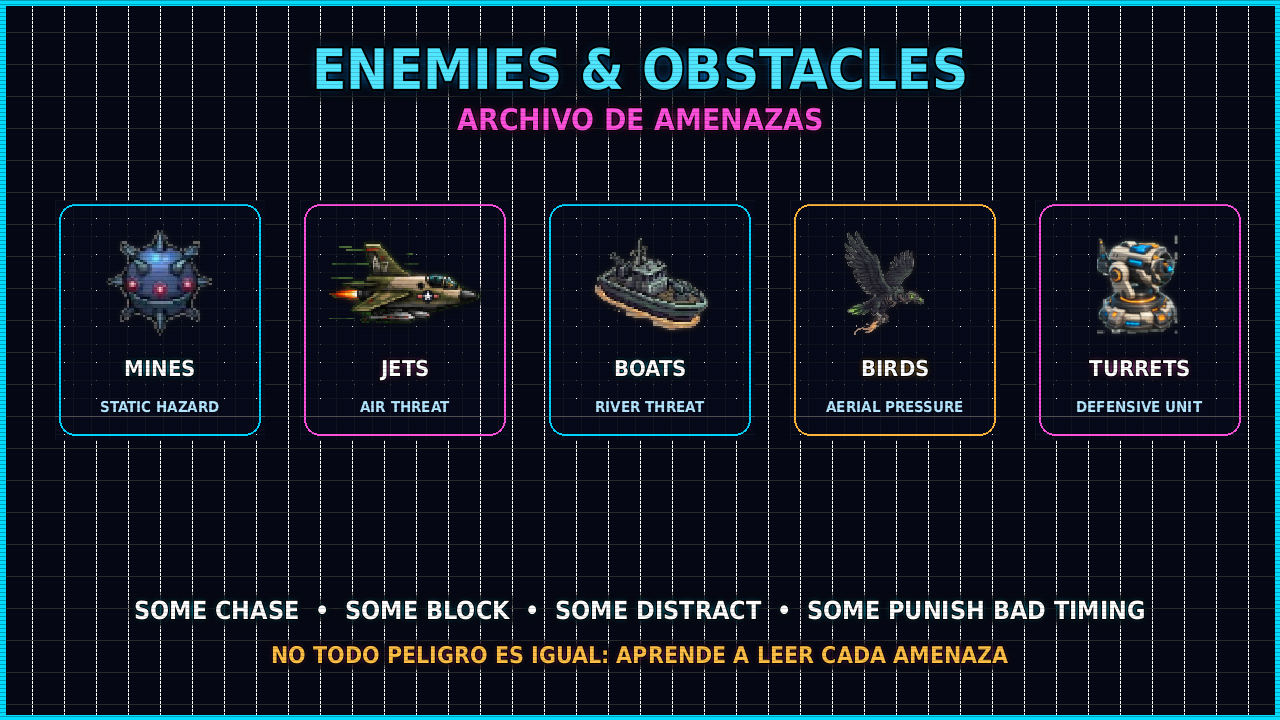
NOT EVERY THREAT SHOULD FEEL THE SAME
If every enemy created exactly the same situation, the player could respond to everything in the same way.
Move.
Fire.
Continue.
I wanted the route to demand more than one kind of reaction.
Some threats are airborne.
Others come from the ground.
Some occupy space.
Some make movement more difficult.
Larger obstacles can change the available route.
And guardians create a different kind of confrontation.
Each category changes the player's attention in a different way.
The goal is not simply to put more objects on the screen.
The goal is to make the player reconsider the route.
AIRBORNE THREATS COMPETE FOR YOUR ATTENTION
An enemy moving through the same space as the ship immediately creates pressure.
The player has to watch its movement while continuing to read the route below.
That creates a conflict for attention.
If you focus only on the enemy, you may stop noticing what is entering the lower part of the screen.
If you look only at the route, you may allow the enemy to move into a dangerous position.
The challenge comes from managing both at the same time.
That is one of the reasons route reading is so important in ALEXX SkyRider™.
The screen is rarely asking only one question.
GROUND DEFENSES CHANGE WHERE YOU WANT TO FLY
Ground-based threats create another kind of problem.
Instead of moving through the screen in the same way as airborne enemies, they can make particular areas of the route less comfortable or more dangerous.
That changes positioning.
A section that might otherwise look open can become a place you do not want to remain in for long.
The player may need to move earlier.
Choose another side.
Or control speed to pass through the area with more confidence.
Again, the threat is doing more than attacking.
It is influencing the route.
LARGE OBSTACLES REDUCE YOUR OPTIONS
A large obstacle does not need to chase the player to create pressure.
Its size can be enough.
The more space an obstacle occupies, the more important the remaining openings become.
That can force the player to think ahead.
Where is the safe side?
Will that opening still be useful when the ship reaches it?
Is there another threat arriving at the same time?
Should I slow down before committing?
A large obstacle can make a simple movement decision feel much more important.
That is useful because the player begins to understand that space itself is part of the challenge.
WHEN THREATS WORK TOGETHER
The most interesting pressure often appears when different threats overlap.
An airborne enemy by itself may be manageable.
A ground defense by itself may also be manageable.
A large obstacle may leave enough room to pass.
But when several of those elements influence the route at the same time, the decision becomes harder.
The player may need to choose between:
avoiding one threat;
destroying another;
protecting an escape route;
reaching Fuel;
or simply surviving the next few seconds.
This is where the game starts asking for priorities.
You cannot always respond to everything at once.
NOT DESTROYING SOMETHING CAN BE THE RIGHT DECISION
In an action game, the natural reaction is often to destroy every enemy.
But survival can require another approach.
Sometimes moving away is more important.
Sometimes keeping a clear route matters more than staying in position to fire.
Sometimes chasing an enemy can place the ship somewhere dangerous.
That is why I like threats that create decisions rather than only targets.
A player who understands the route may sometimes choose not to force an attack.
That is still active play.
It is choosing survival over an unnecessary risk.
GUARDIANS CHANGE THE SCALE OF THE MOMENT
Guardians such as the Yeti and the Stone Man create a different feeling from smaller threats.
Their presence changes the scale of the encounter.
The player is no longer dealing with only another object passing through the route.
The section becomes a confrontation.
That gives the journey moments with a different rhythm and weight.
The goal is still survival.
The player still needs to read movement and space.
But a guardian makes the moment feel more significant.
That contrast helps keep the journey from feeling like one continuous stream of identical encounters.
PRESSURE SHOULD AFFECT MOVEMENT
For me, one of the most useful questions when thinking about a threat is:
Does this change how the player moves?
If the answer is yes, the enemy or obstacle is doing more than filling the screen.
It is affecting gameplay.
A threat can push the ship toward one side.
Force the player to leave the center.
Make braking useful.
Make acceleration dangerous.
Reduce the number of safe openings.
Or distract attention at exactly the wrong moment.
Those effects are what make different threats feel meaningful.
THE SCREEN BECOMES A SET OF PRIORITIES
As more elements appear, the player gradually stops seeing the screen as a collection of separate objects.
Instead, the screen becomes a set of priorities.
What is the biggest danger?
Which opening needs to stay clear?
Can this enemy be ignored for a moment?
Is moving safer than firing?
Do I have enough space to recover if something changes?
That is the kind of thinking I wanted the pressure system to encourage.
The player is not only reacting.
The player is deciding.
DIFFICULTY DOES NOT HAVE TO MEAN “MORE OF EVERYTHING”
Pressure can increase without simply filling the screen with more objects.
A different combination can be enough.
A threat arriving from another direction.
A smaller opening.
A worse position.
Less time to react.
A guardian appearing after the player has already been under pressure.
Those situations can change the feeling of a section without changing the basic controls of the game.
That is important because ALEXX SkyRider™ should become harder while still feeling understandable.
The player should be able to learn from what happened.
DESIGNING DECISIONS, NOT JUST ENEMIES
That is how I think about the threats in ALEXX SkyRider™.
An enemy is not interesting only because of how it looks.
An obstacle is not important only because it can cause a collision.
Their real value comes from what they make the player consider.
Move now?
Wait?
Fire?
Brake?
Change sides?
Protect the exit?
Leave something behind?
Those decisions create the pressure.
And that pressure is what makes the route feel alive.
READ THE ENTIRE SCREEN
The best way to survive is not to stare at one threat until it disappears.
Keep reading the whole screen.
Watch the route.
Protect your escape space.
Notice what is approaching.
And understand that sometimes the most dangerous enemy is not the one closest to the ship.
It is the one changing where you will be able to move next.
That is why different threats matter.
They do not only attack the player. They change the decisions the player has to make.